By Ivan Kwok | 06 February 2026 | 0 Comments
Will Steadicam Be Replaced by Gimbals in the AI Era?
Starting with ARRI TRINITY & "Budget Trinity": The Next Stage of Stabilization is Fusion, Not Elimination.
Why are more people "hooking" their increasingly smarter gimbals back onto vestarm systems?
A latenight comment hit home: "I can keep the shot stable, but I can't keep shooting." If you've worked on film sets, weddings, documentaries, live streams, or short videos, you understand: stability is never just about "steady or not." It's a complex battle of physical stamina, efficiency, budget, aesthetics, and reliable delivery. This is why the debate rages: With AI getting stronger and gimbals getting smarter, will Steadicam be replaced?
My conclusion: It will be "eroded in more scenarios" but is unlikely to be "completely replaced." Because they solve two fundamentally different problems.
Gimbal + AI: Makes "control" and "lowbarriertoentry stability" increasingly powerful.
Steadicam: Keeps the "spatial float" and the unique "flavor of Zaxis isolation."
Let's unpack this, supported by data, facts, and realworld industry choices.
1) The Big Trend in Data: The Gimbal Market Grows, Steadicam Becomes More "Niche"
From a market size perspective, pocket gimbals and stabilizers are in a clear growth phase. Globally, the "Camera Gimbal Stabilizer" market is still projected to grow over the next decade. Underlying this is a structural shift:
Lighter Gear: Mirrorless cameras, pocket gimbals, and phones are now the mainstream tools.
Faster Content: Shortform video and live streaming have made "stability" a highfrequency necessity.
Smaller Teams: Solo operators/small crews prioritize "quick to learn, quick to deliver."
The realistic conclusion: Many mediumtolow intensity scenarios that once "required a Steadicam for stability" have indeed been taken over by gimbals—especially jobs demanding fast delivery, minimal crew, and where an "algorithmic feel" is acceptable.
2) So Why Hasn't Steadicam Died? Because Its "Stability" is Not the Same Kind
Since its invention by Garrett Brown in the 1970s, Steadicam's core solution was never "electronic correction," but "mechanical isolation" and "ergonomics."
The difference in one sentence:
Gimbal: More like "actively pulling the frame back" (motorized closedloop control).
Steadicam: More like "letting the frame float naturally" (inertia + mechanical isolation + body loadbearing).
This is the "flavor" many cinematographers talk about—the spatial sense in a corridor push or a close follow; more direct Zaxis (vertical) isolation where footstep bounce is more easily "absorbed" by the mechanical structure; in long takes, the shot feels more like "a person moving through space" rather than "a machine locking the frame."
Thus, you'll notice: when a project's aesthetic demands rise and shot language becomes more deliberate, Steadicam's presence rebounds.
3) A Key Signal: Why Did Even ARRI Choose to "Blend" the Two Paths?
What's truly noteworthy isn't "who replaces whom," but the "fusion" happening in highend circles.
ARRI's TRINITY isn't a simple "upgraded gimbal." It's a hybrid stabilization system:
Lower Half: A traditional Steadicam vest + spring arm (handles weight distribution, Zaxis isolation, longduration shooting).
Upper Half: An electronic 3axis gyro gimbal (handles precise control of tilt, roll, pan).
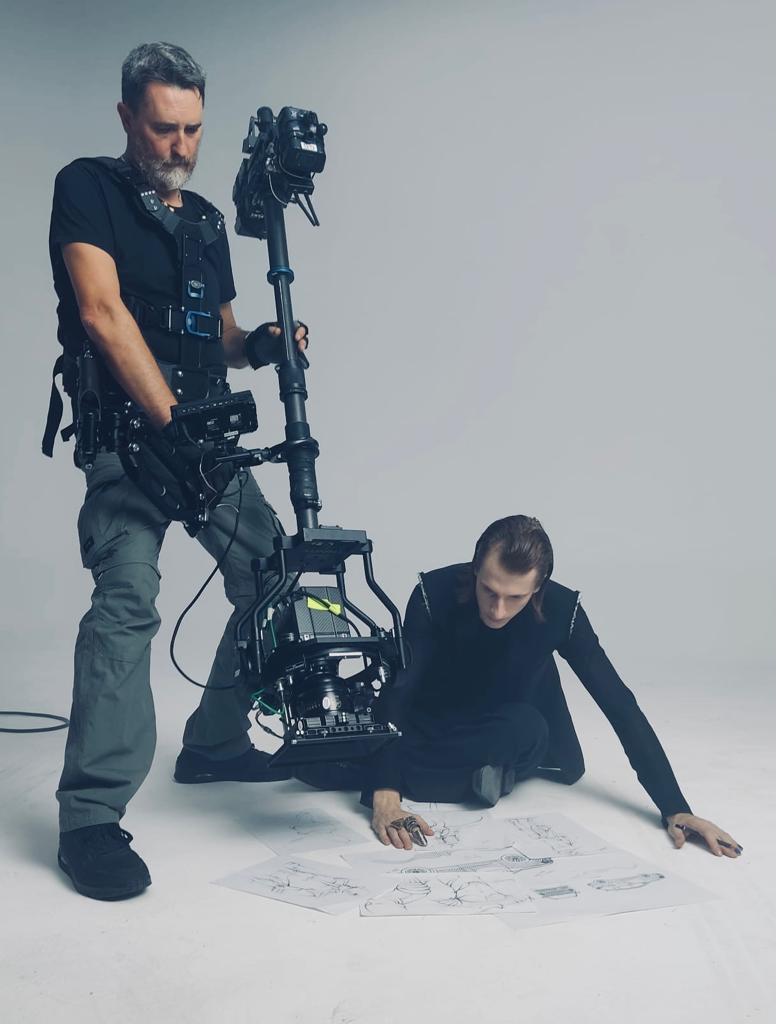
Its goal is clear: retain the "spatial float" of the mechanical system while introducing the "precise control and repeatability" of the electronic system. ARRI's official positioning addresses a longstanding pain point: pure gimbals often struggle to achieve both smoothness and a sense of "weight" or "breathing" in long takes with continuous tilt changes.
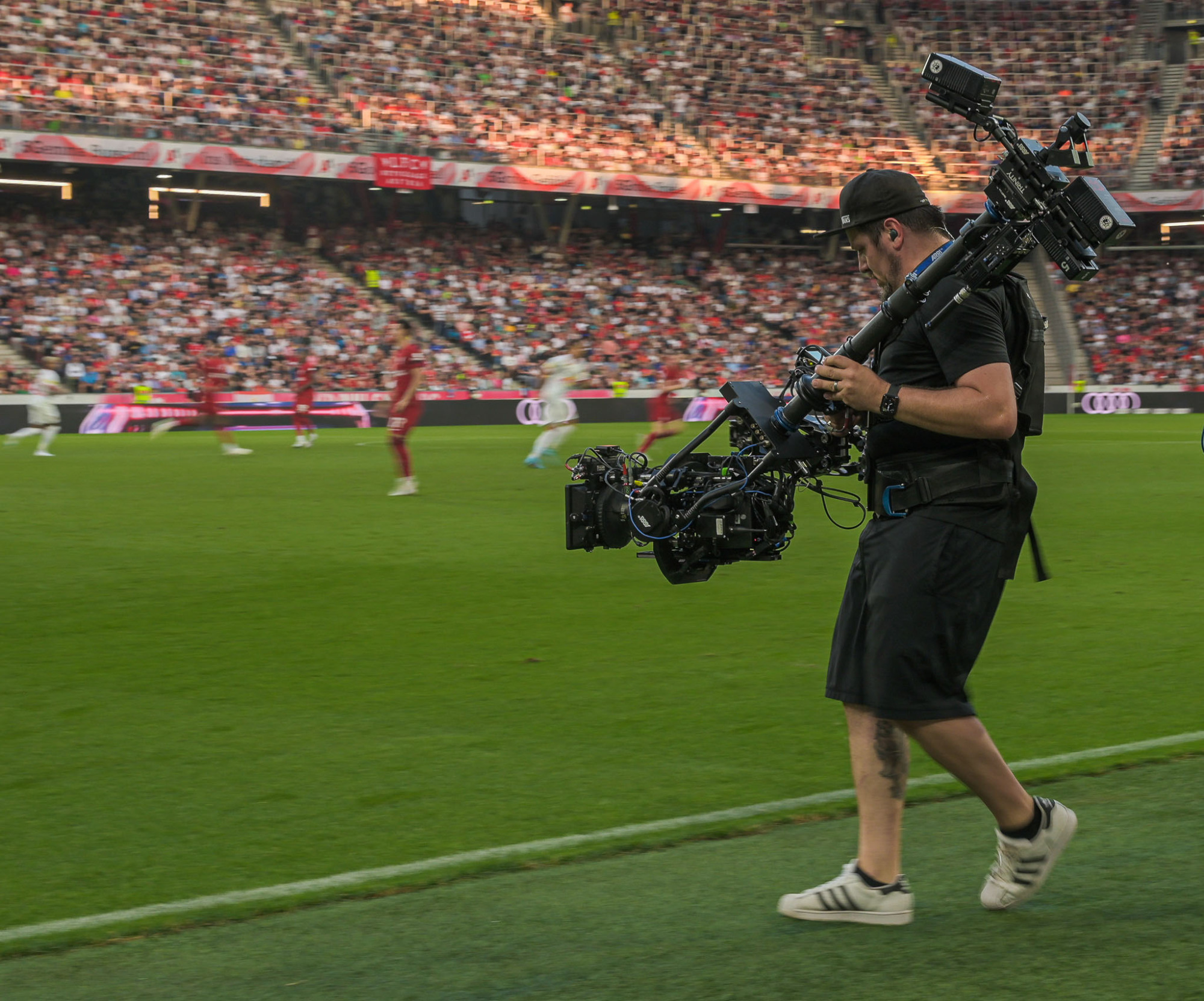
Typical scenarios: smoothly lifting from a low angle to a subject's face; following someone up stairs, down slopes, across elevation changes; long takes requiring continuous tilt changes while maintaining a sense of "inertia" in the frame. Relying solely on motors for these can easily result in an "electronic correction feel"—the shot is stable, but lacks that natural, physicallygrounded feedback.
4) A More RealWorld Industry Choice: The Global Wave of "Budget Trinity"
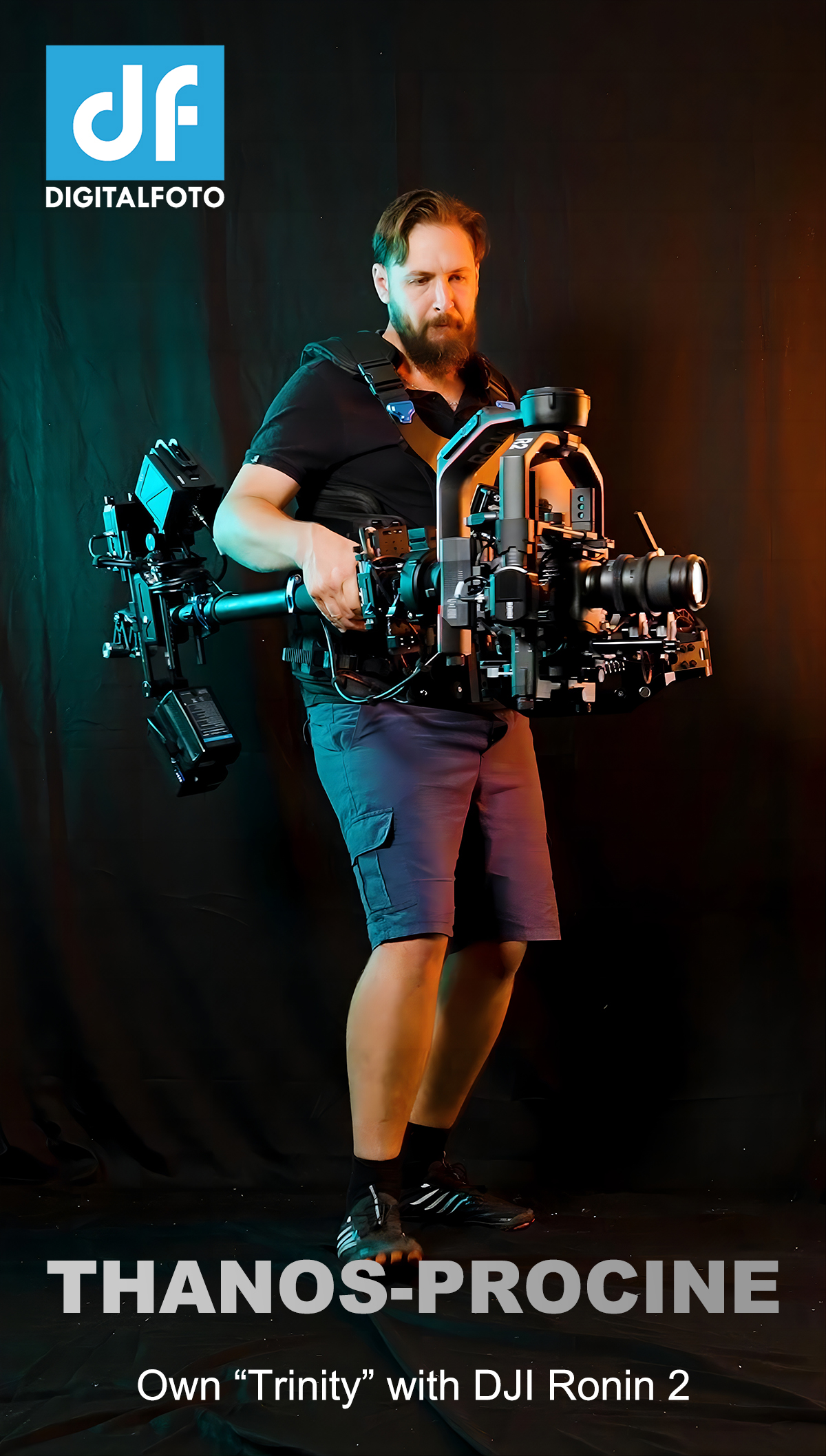
Beyond the high price and steep learning curve of the TRINITY, a significant "Budget Trinity" movement has emerged organically among global operators.
The typical setup: a Steadicam vest + spring arm (solves weight and Zaxis) with a gimbal (like a Ronin 2 or RS series) mounted on top (solves precise attitude control). This isn't "fussing around"; it's the spontaneous evolution of need. They found that pure gimbals can feel "locked" or "jerky" on tilts, with a heavy electronic feel, while pure Steadicam tilt control relies entirely on feel, offering limited precision and repeatability. The hybrid system perfectly complements both weaknesses.
This precisely illustrates: cinematographers aren't choosing "Steadicam OR gimbal," but searching for "stabilization methods more aligned with the human body and cinematic language."
5) Where Will AI Push Gimbals?
First, it will replace "lowaestheticcost stability," then approach "advanced control." AI's impact on stabilizers often isn't about "eliminating a category," but shifting the value proposition:
Before: Selling "hardware specs"—payload, battery life, wind resistance.
Future: Selling "system outcomes"—less learning curve, more reproducibility, faster delivery.
What's more likely to happen:
AI makes gimbals better at "predicting motion"—anticipating gait, foreseeing turns.
AI makes "poststabilization/shake reduction" stronger—leveling the playing field for midrange hardware.
AI enables "oneclick workflows"—presets and autoedits for different scenes.
⚠️ However, AI can't solve your physicalworld problems.
Your arms will still get tired. How your gear distributes weight still determines how long you can shoot. Your spatial blocking and improvisational moves on set are still "physically constrained." This is why, as technology advances, the need for "physicallayer stability" (load reduction, Zaxis isolation, ergonomics) becomes more, not less, defined.
6) Why Does the "HighEnd Circle" Still Trust Steadicam More?
—Trust Chains, Consistency, and Reproducibility
In highend film/ad production, the purchasing logic is "systembased" not "personal consumption." This builds an extremely high trust threshold:
1. Professional Circle Trust Chain: Brands and systems repeatedly validated by rental houses, cinematographers, and operators.
2. Consistency & Reproducibility: Every unit performs the same, with consistent balancing logic, low and predictable failure rates.
3. The Experience Ceiling—The Pursuit of "IsoElasticity": Professional systems pursue isoelastic arms, where the supporting force remains more constant throughout the arm's range, leading to smoother Zaxis movement and a more uniform feel. This is deep mechanical engineering accumulation.
For domestic Steadicam brands aiming to enter the highend circle, the key isn't "bigger specs," but building the "systematic, reliable delivery" trust chain:
Transparent version evolution and key structural changes.
Clear quality control standards (batchtobatch consistency).
Traceable maintenance and spare parts systems (the lifeline for rental houses).
7) A Route Suggestion for Chinese Steadicam: Don't "Fight Gimbals HeadOn," but "Embed into the Workflow"
The "Steadicam market" isn't just being eroded by the Ronin 4D or onehanded RS series, but by the full explosion of pocket cameras and phone+AI editing. Therefore, a more realistic, highprobability route is: "Productize Steadicam's physical advantages into modules gimbal users can immediately adopt."
A. Build "systematic, reliable delivery" to complete the trust chain.
B. Focus on "reproducibility," not "bigger parameters."
C. Productize core physical advantages: e.g., loadreduction vests, Zaxis damping modules, integrated power/distribution solutions. Because no matter how strong AI gets, it won't solve the problem of "your arm being shot after a day of filming."
8) Returning to Steadicam's Essence: Four Key Points for "Most Worth Practicing, Most Likely to Stabilize You Instantly"
No matter how gear evolves, human skill remains core. If you're starting from 0→1 or pursuing "shooting smoothly," these four points matter more than any spec:
1. Practice walking first: Small steps, heeltotoe roll, lead with your body, don't twist with your wrists.
2. Then practice static balance: Any tiny imbalance is magnified in motion.
3. Third, practice "Zaxis feel": The goal isn't "stiffness," but "controlled float," with even resistance when booming up/down.
4. Finally, "attitude control": Whether your tilts are smooth determines if your shot "looks cinematic."
9) A Common "Budget Trinity" Pitfall: Why Does the Gimbal Shake When Mounted on Steadicam?
System coupling issue: When a Ronin 2/RS4/RS5 etc., is mounted on a Steadicam carbon post, shaking often isn't due to broken equipment but "control system and mechanical system coupling/resonance." Systematic solution (in order of priority):
1. Ensure perfect static balance of the gimbal (doesn't drift at any angle when powered off).
2. Optimize gimbal motor parameters: Significantly lower "Stiffness," increase "Filter," significantly increase "Deadband" to make the gimbal "ignore" microshakes.
3. Soften the spring arm tension, making it more "compliant" to avoid fighting the motors.
4. Check and tighten all connection points (microlooseness gets amplified).
5. Shorten the carbon post length (reduces lever effect).
Conclusion: The Next Stage of Stabilization Belongs to Those Who Understand "People" and "Cinematic Language"
The emergence of ARRI TRINITY and the spontaneous "Budget Trinity" among frontline operators point to the same conclusion: The future of stabilization isn't "gimbals killing Steadicam," but "combining the loadreduction and Zaxis advantages of the physical layer with the precise attitude control of the electronic layer."
AI will make "getting stable" easier and easier, but it will make the ability to "stay stable longer, look more cinematic, and deliver more reliably" increasingly scarce.
Thus, the future looks more like stratification:
Mass Layer: AI gimbals + phones/pocket cameras cover most production.
Professional Layer: Steadicam/hybrid systems/stronger ergonomic systems remain entrenched.
Middle Layer: The most competitive arena—competing on "workflow integration and ergonomic optimization."
Technology will inevitably progress, but one simple fact remains unchanged: To shoot longer, shoot smoother, and shoot more cinematically—you must respect the constraints of the human body and the physical world.
Leave a Reply
Your email address will not be published.Required fields are marked. *