From Products to Workflows: DIGITALFOTO at IBC 2026
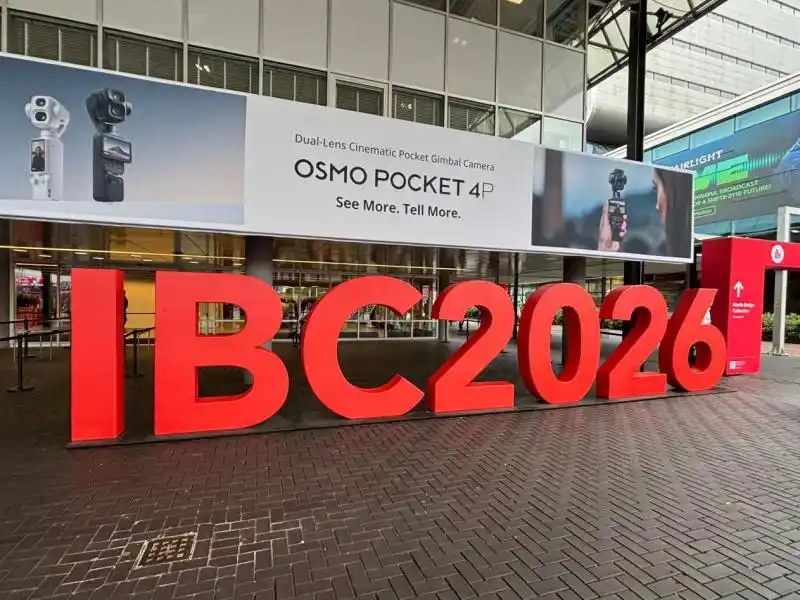
From September 11–14, DIGITALFOTO returned to Amsterdam for IBC 2026, one of the most important global gatherings for the media, entertainment and production-technology industries.
This year, IBC welcomed 41,225 attendees from 170 countries and more than 1,300 exhibitors to the RAI Amsterdam. Beyond the numbers, the show reflected an industry increasingly focused on turning new technology into practical solutions for real production environments. IBC 2026
For DIGITALFOTO, IBC 2026 was not simply another opportunity to introduce new products.
It was a chance to ask a bigger question:
How can equipment reduce friction in the creative process, rather than adding more complexity to it?
That question is becoming increasingly important to the way we develop products—and to the way we define DIGITALFOTO as a brand.
From Better Equipment to Better Workflows
Before IBC, we wrote about an important change we had observed across the imaging industry.
Professional cameras continue to become more capable. Compact cameras are moving into increasingly serious production environments. Smaller teams are expected to create more content, more quickly. At the same time, AI, automation and new creator platforms are changing how images are produced and distributed.
As these technologies develop, the surrounding workflow becomes increasingly important.
A camera does not work alone.
It needs to be carried, mounted, powered, stabilized, adjusted, moved, monitored and integrated with other equipment.
This is why DIGITALFOTO is gradually moving beyond the idea of developing isolated camera accessories.
We are thinking more about the complete environment around the creator.
At IBC 2026, that direction could be seen across products ranging from production carts and professional body-support systems to mounting tools, batteries and accessories for pocket cameras.
The products may look very different.
The thinking behind them is becoming increasingly consistent.
Support the equipment.
Support the workflow.
Support the creator.
TITAN-LITE: Making Production Mobility More Accessible
One of the products that attracted strong interest at IBC was the TITAN-LITE modular production cart.
Professional productions often involve far more than a camera. Monitors, tripods, lenses, lighting equipment, power systems, cables, tools and computers all need to move through the set efficiently.
TITAN-LITE was developed around this reality.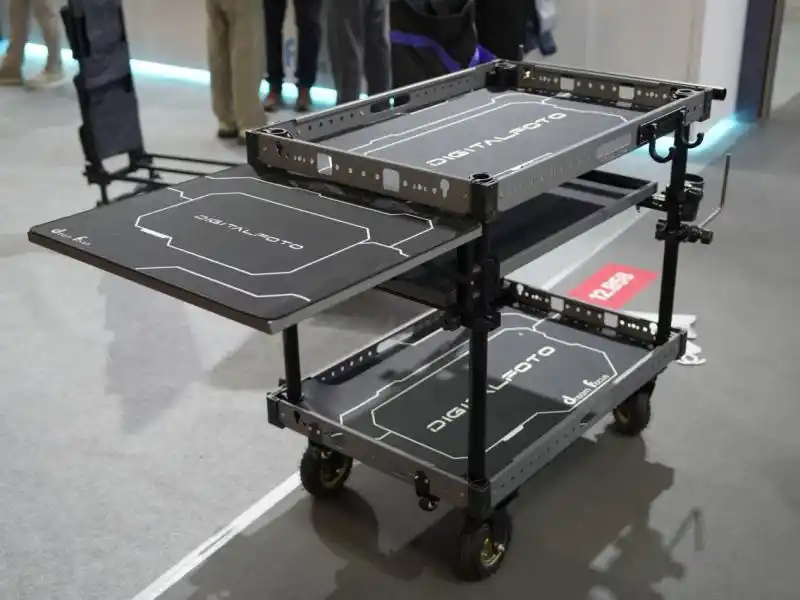
Built with a steel structure, the cart weighs approximately 33kg in its base configuration and supports payloads of up to 220kg. It can also be expanded with monitor mounts, extension poles, cable hooks, tripod holders, work surfaces and other accessories.
The foldable structure is designed to make transportation and location changes easier while maintaining the carrying capacity required for professional production.
CineD also visited our booth during IBC and took a closer look at the TITAN-LITE, discussing its 220kg payload, steel construction and the idea of creating a more accessible production cart for filmmakers and crews. CineD
For us, a production cart is not simply a way to move equipment.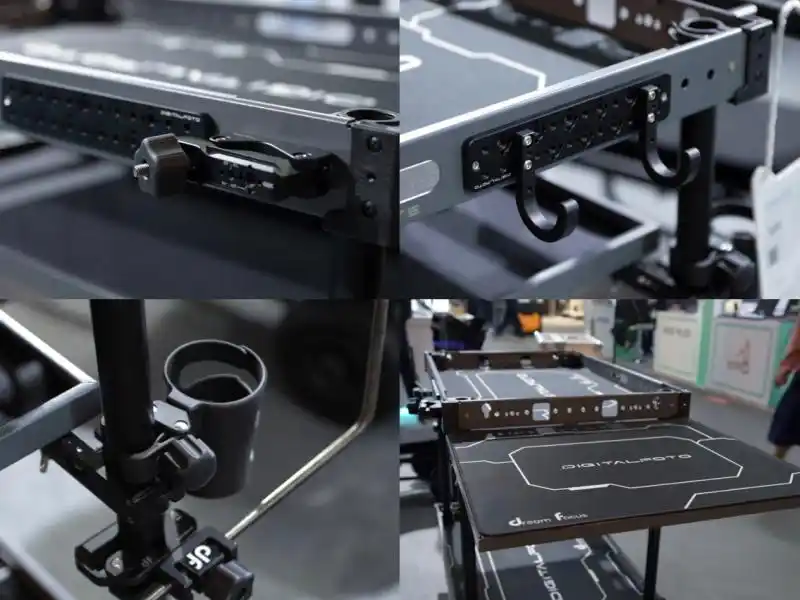
It can become a mobile workstation around which part of the production workflow is organized.
That distinction is important.
THANOS-PROCINE ELITE: Supporting the Camera—and the Operator
The new THANOS-PROCINE ELITE represents another part of our workflow philosophy.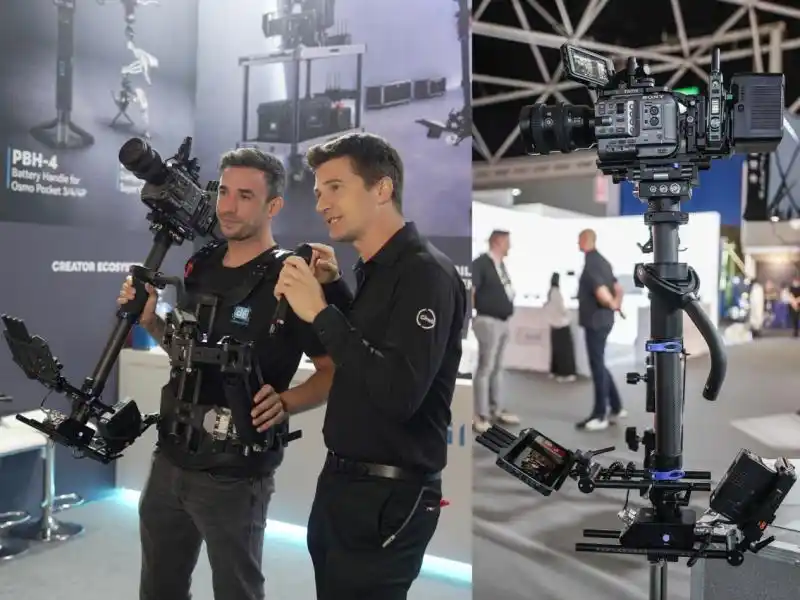
Camera stabilization is traditionally discussed in terms of image movement.
But when a camera operator carries a professional cinema system for hours at a time, stabilization is also a question of physical workload.
Based on the existing THANOS-PROCINE platform, the ELITE version introduces a redesigned vest, an upgraded ISO-elastic arm system and carbon-fiber components, with support for camera setups from approximately 5kg up to 30kg.
The goal is not only to stabilize the camera, but also to improve weight distribution, movement and long-duration operating comfort.
CineD covered the system following its IBC demonstration, highlighting the 30kg maximum payload, redesigned vest and updated iso-elastic arm. 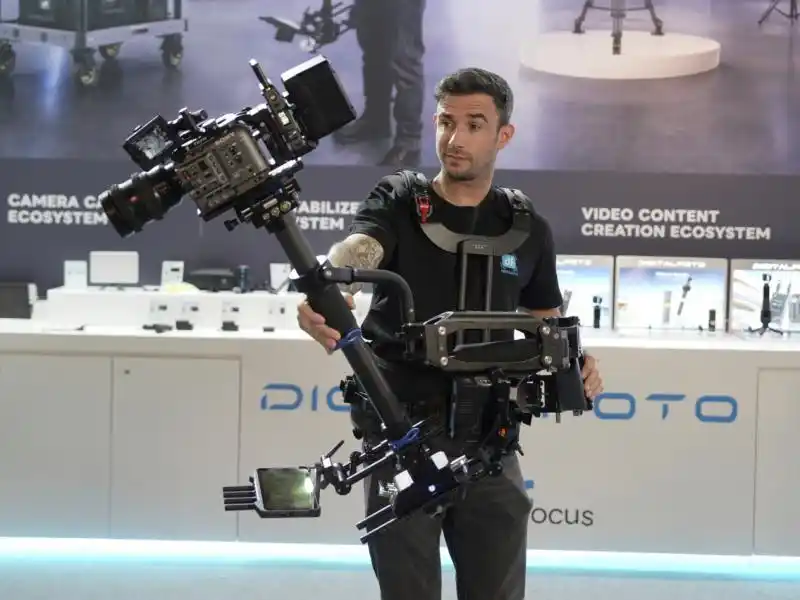
This reflects an idea that has become increasingly important to us:
Equipment should extend the creator’s ability—not become another burden the creator has to fight against.
A professional support system therefore has to be designed around both the camera and the human body operating it.
IRON: A Mounting System Designed Around Faster Adjustment
Small pieces of equipment can have a surprisingly large impact on a production day.
A monitor needs to move.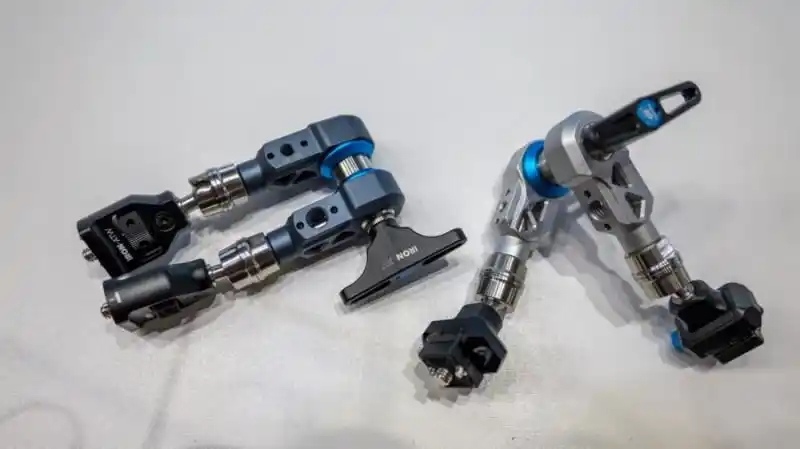
A light has to be repositioned.
An accessory needs to be transferred from one rig to another.
The time spent repeatedly loosening, removing, rebuilding and locking equipment may seem insignificant individually—but across an entire shooting day, those interruptions add up.
At IBC 2026, DIGITALFOTO presented the latest generation of the IRON damping magic arm ecosystem, including 7-inch and 11-inch versions.
Instead of relying only on traditional toothed joints, the IRON concept uses damping to allow more continuous adjustment while maintaining position under load.
The ecosystem also introduces interchangeable mounting options including F22, NATO and 1/4-inch interfaces, together with the new Sabertooth Clamp.
CineD described the new IRON series as an evolution from the earlier IRON-311QD into a broader family of arms, interchangeable heads and mounting solutions, with a vertical payload rating of up to 5kg.
The idea is simple:
less time rebuilding the rig, more time using it.
That may sound like a small improvement.
On a real set, small improvements are often what make a workflow better.
VB79: Rethinking Professional Power for Smaller Crews
Power is another part of the production workflow that is changing.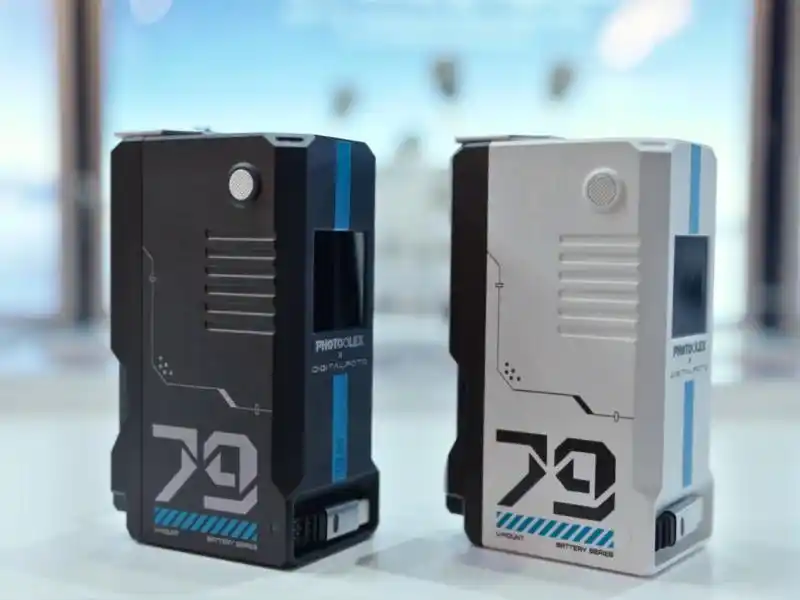
V-mount batteries were once associated primarily with large cinema cameras and broadcast systems.
Today they are increasingly used with compact rigs, monitors, mobile workstations, lighting systems, laptops and smaller creator setups.
At IBC, we introduced the DIGITALFOTO × PHOTOOLEX VB79, a compact 79.2Wh V-mount battery developed for this changing production environment.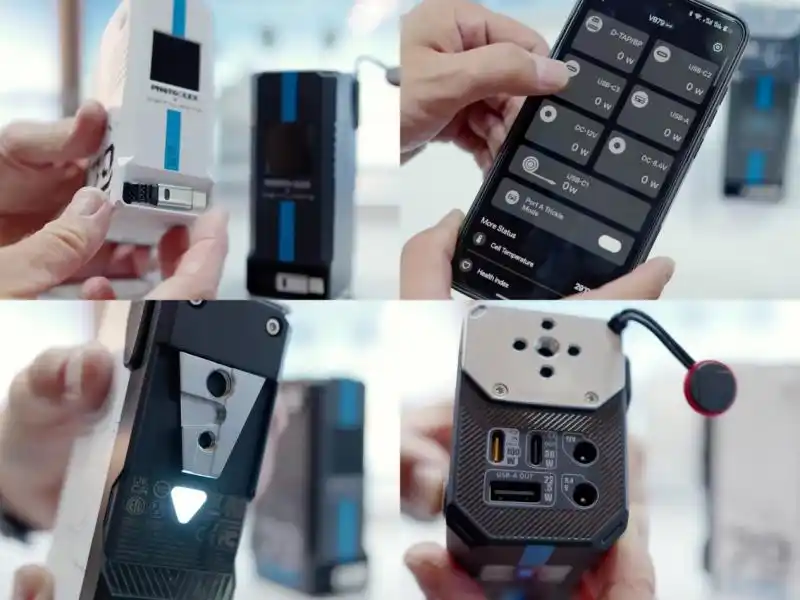
The VB79 supports up to 500W total output, includes a built-in retractable 100W USB-C cable, and provides USB-C, USB-A, D-Tap and DC connectivity in addition to its professional battery interface.
Its smaller 79.2Wh capacity also keeps the battery below the common 100Wh airline threshold applied to lithium-ion batteries carried in cabin baggage, making it particularly relevant for mobile production teams and travelling creators. CineD interviewed us at IBC and published a detailed examination of the design, connections, charging options and intended use cases. CineD
What interested us most was not simply putting more ports onto a battery.
It was asking:
What does professional power look like when the production team becomes smaller and more mobile?
From Cinema Cameras to Pocket Cameras
One of the most visible changes in today's imaging industry is the increasingly fluid boundary between the traditional filmmaker and the content creator.
A cinematographer may work with a professional cinema camera on one production and a pocket-sized camera on another.
A commercial studio may shoot a campaign with a full crew while producing daily social content using much smaller systems.
The cameras are different.
The underlying needs are often surprisingly similar:
reliable power;
stable mounting;
longer operating time;
fast setup;
fewer interruptions.
That is why DIGITALFOTO also brought new battery handles for the DJI Osmo Pocket and Insta360 Luna platforms to IBC.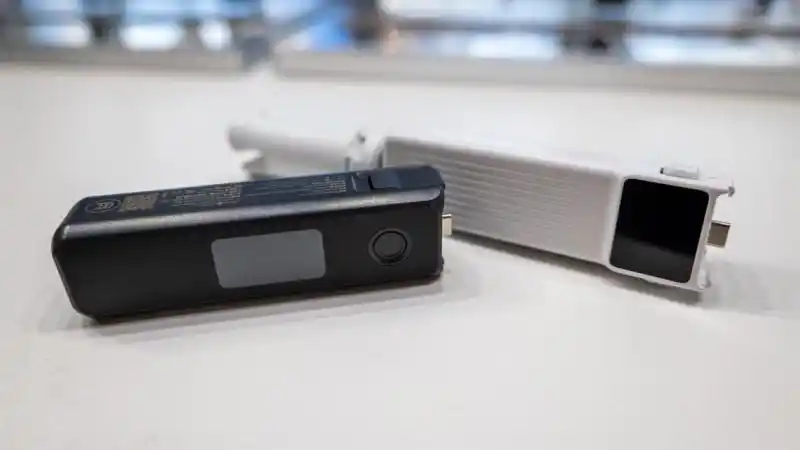
The handles incorporate a 5000mAh battery, a color status display, 20W quick charging and a bottom 1/4-inch mounting point.
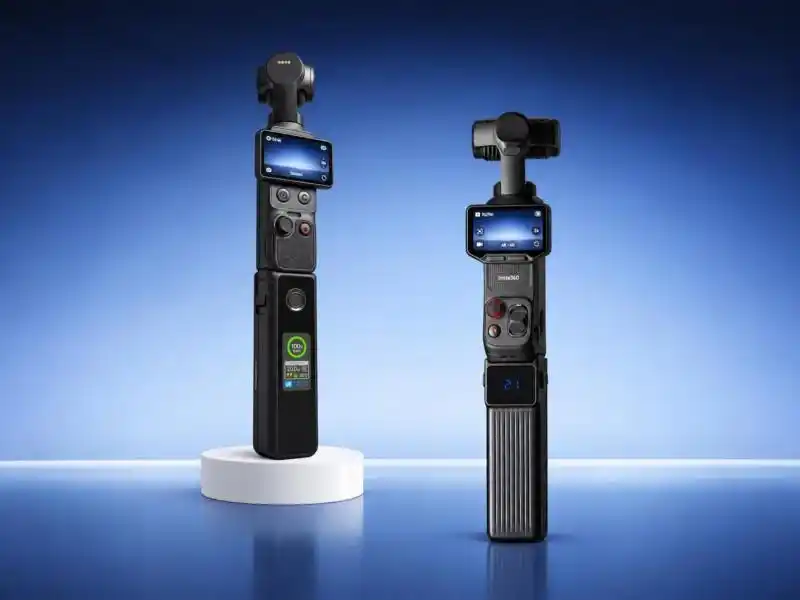
CineD later covered the products following an interview at our booth, noting how the designs extend operating time while also creating a more functional grip and mounting platform for compact cameras.
For DIGITALFOTO, entering this category does not mean moving away from professional filmmaking.
It means bringing professional workflow thinking to a broader generation of creators.
Different Products, One Direction
A production cart.
A body-mounted stabilization system.
A magic arm.
A V-mount battery.
A battery handle for a pocket camera.
At first glance, these products belong to very different categories.
But on a real production, the problems they address are closely connected:
transportation, mounting, stabilization, power, setup time, physical workload and mobility.
This is becoming the underlying logic of the DIGITALFOTO portfolio.
We do not want to expand simply by adding more SKUs.
Instead, we want to follow the real production process and identify individual points of friction along the way.
Solve one problem well.
Listen to the people using the product.
Then move naturally toward the next related problem.
Over time, individual products begin to form a more connected ecosystem.
IBC Is Also About Listening
An exhibition is useful because products can be demonstrated.
But its greater value is often the conversation that happens around those products.
At IBC, we spoke with cinematographers, camera operators, production professionals, dealers, media representatives and creators from different markets.
Those conversations allow us to hear things that are difficult to understand from sales data alone.
How is this product actually being used?
What takes too long on set?
What is unnecessarily heavy?
Which accessory is missing?
What works well in China but needs to change for a European customer?
Those questions matter because DIGITALFOTO increasingly wants product development to be informed not only by our own ideas, but also by a continuous feedback loop between:
product → channel → professional user → product development.
International media coverage during and after IBC also helped extend that conversation. CineD reported separately on the VB79, TITAN-LITE, THANOS-PROCINE ELITE, IRON damping arms and the compact-camera battery handles, giving international creators a closer look at several parts of the DIGITALFOTO product direction.
Going Deeper into the European Market
IBC was also part of a larger journey for DIGITALFOTO in Europe.
For a Chinese imaging brand, entering Europe cannot simply mean shipping products from China to European customers.
A brand has to become understandable, accessible and reliable in the local market.
That means thinking about:
local communication,
dealers,
inventory,
fulfillment,
after-sales support,
product training,
and ultimately the relationship between the brand and the people using its equipment.
During the trip, the DIGITALFOTO team met with local dealers and industry partners in the Netherlands to discuss market conditions, channel development and the needs of professional users.
We also visited our UK distributor PiXAPRO, where we continued product discussions and training together with DIGITALFOTO brand ambassador Malcolm Modele.
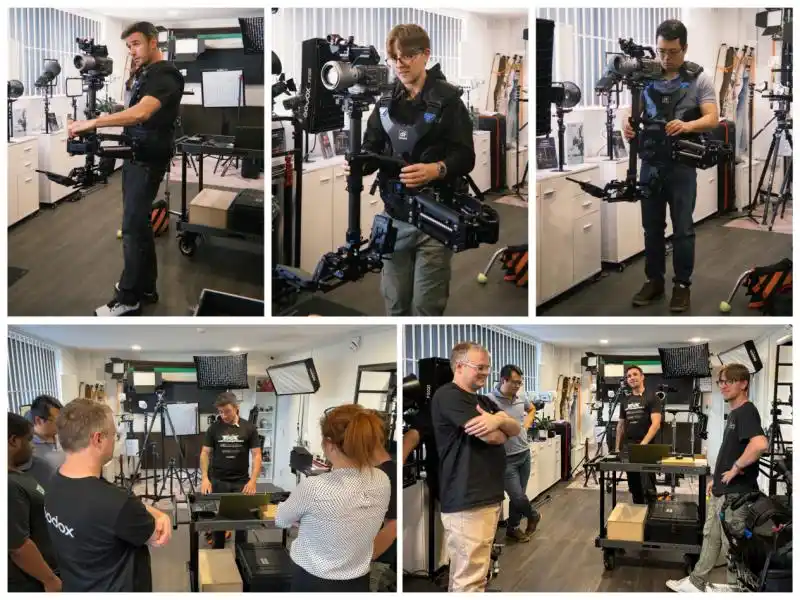
Malcolm also joined us at IBC, where he demonstrated products including the THANOS-PROCINE ELITE and TITAN-LITE to international media and visitors. CineD's coverage of both products included demonstrations and explanations from the DIGITALFOTO booth. CineD
These meetings reinforced something we increasingly believe:
internationalization is not measured by how many countries a product has been shipped to.
It is measured by whether a brand gradually develops the systems needed to understand and serve those markets.
From Exporting Products to Building a Global Brand
DIGITALFOTO originally grew by developing practical equipment and accessories for photographers and filmmakers.
As we have worked with more international users, dealers and production teams, our understanding of the business has evolved.
The next stage is not simply about selling more individual products in more countries.
It is about building a stronger system for understanding:
products,
markets,
channels,
and people.
This also changes how we think about the DIGITALFOTO brand.
In the past, DIGITALFOTO may have been understood primarily as a photography and video-accessory company.
Going forward, we increasingly see ourselves as:
A global visual-production technology brand that understands both equipment and the people using it.
That positioning had already begun to emerge before IBC, as we described our evolution from individual accessories toward tools and ecosystems built around real-world production workflows.
IBC 2026 gave us another opportunity to test that direction against the real market.
And it made us more confident that this is the direction worth continuing.
Technology Should Leave More Space for Creativity
Technology is becoming more powerful.
Cameras are getting better.
AI is changing production.
Automation is becoming more accessible.
Smaller teams can now accomplish things that once required much larger crews.
But the purpose of technology should not be to make the production process feel more complicated.
For us, its value ultimately comes back to the person behind the image.
A good tool should help a creator:
move more freely,
carry less unnecessary weight,
set up faster,
solve problems with fewer steps,
and spend less attention managing equipment.
Because every minute not spent fighting the tools is another minute that can be spent thinking about the image.
That is what connects the different products we brought to Amsterdam.
And that is the direction DIGITALFOTO intends to continue exploring after IBC 2026.
Start with a real problem.
Build a better tool.
Listen to the people using it.
Then keep moving forward.
DIGITALFOTO
Dream. Focus. Create Your World.